


Mountaineering boots
Mountaineering boots
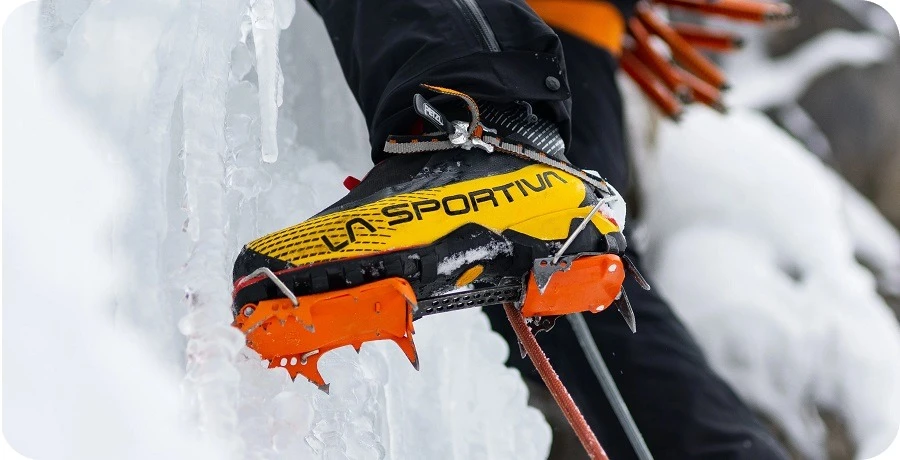
Mountaineering boots are technical footwear designed specifically to provide protection, thermal insulation, stability, and support in high-mountain terrain—including snow, ice, and vertical rock. Unlike conventional hiking boots, they feature a highly rigid sole, which is essential for safe movement and for the attachment of crampons.
When choosing the right mountaineering boots, your decision should be based on three fundamental pillars: the type of activity (terrain and technical difficulty), compatibility with crampons, and the required level of thermal insulation.
1. Types of boots based on rigidity
The standard international classification categorizes boots by their rigidity to determine their intended use in the mountains:
Semi-rigid boots (Category B2)
These are the most versatile. Their soles allow for some flex, making them comfortable for walking during the approach phase, yet they retain enough structure for technical rock terrain, ridgelines, and straightforward glacier crossings.
• Ideal use: Summer mountaineering, ascents of 3,000-meter peaks (such as in the Pyrenees), ridgeline traverses, and glacier crossings.
• Advantages: Comfortable for long hikes.
Rigid boots (Category B3)
These feature completely inflexible soles. They are designed to transfer all force directly to the points of the crampons, which helps prevent foot fatigue when climbing vertical faces.
• Ideal use: Winter mountaineering, ice climbing, technical couloirs, and expeditions.
• Advantages: Maximum stability on steep slopes and superior thermal insulation.
2. Compatibility with crampons
The boot and the crampon must function as a single, solid unit. Look for the notches or grooves on the sole of the boot:
• Semi-automatic (C2): The boot has a groove or attachment point only at the heel. This is the standard system for semi-rigid (B2) boots.
• Automatic (C3): These crampons feature attachment points at both the toe and the heel. They are designed exclusively for fully rigid (B3) boots and provide the most secure fit for technical ice climbing.
• Strap-on (C1): These can be fitted to almost any boot (including flexible B1 boots), but they offer less precision and are intended only for flat traverses or walking on soft snow.
3. Single or Double Boots?
Thermal insulation requirements depend on altitude and the time of year:
• Single Boots: These consist of a single, integrated structure. They are lighter, more precise, and more agile—ideal for summer mountaineering or single-day winter ascents in Europe (up to approximately 4,000 meters).
• Double Boots: These feature a removable inner liner (bootie) and an outer shell. The liner can be placed inside your sleeping bag at night to prevent it from freezing. They are essential for multi-day expeditions, extreme cold, or high-altitude summits (such as those in the Andes or the Himalayas).
Mountaineering Boots at Tècnic Esports
At our store, you will find a wide selection of mountaineering boots. Choosing the right pair is crucial for ensuring your safety, performance, and comfort in high-mountain terrain.
Want to see them in person? Visit us at Tècnic Esports, Encamp — expert advice on skiing, mountaineering, and climbing.


